Impli selected for SPRIND's Continuous Hormone Monitoring Challenge, backed with up to €6M to bring continuous monitoring to PMOS
Press Release-17 September 2026
Impli is one of eight teams chosen for Stage 1 of SPRIND's three-year Challenge to build the first continuous, multi-hormone biosensors, extending its BEAM platform beyond IVF into real-time treatment monitoring for PMOS (Polyendocrine Metabolic Ovarian Syndrome, formerly known as PCOS).
London, UK / Leipzig, Germany, 17 Sept 2026: Impli, the deep-tech company building a continuous molecular monitoring platform for hormonal health, has been selected as one of eight teams to enter Stage 1 of the SPRIND Challenge: Continuous Hormone Monitoring, run by SPRIND (Bundesagentur für Sprunginnovationen, Germany's federal agency for breakthrough innovation). The award provides Impli with at least €1.5 million for Stage 1 and a total of up to €6 million over 36 months to extend its BEAM biosensing platform from three hormones to five, and from a single-condition application in IVF to real-time treatment response tracking in PMOS.
The challenge
SPRIND's Challenge calls for biosensors that can continuously measure at least four hormones over seven consecutive days, directly in a biological matrix such as interstitial fluid, sweat or saliva, without the information loss of episodic sampling. It is structured in three stages over three years, with funding rising from €1,5 million in Stage 1, to €2 million in Stage 2 and €2.5 million in Stage 3 for the teams that progress. Alongside Impli, seven other teams were selected for Stage 1, including Level Zero Health, MoleSense and Kāhu SiliconBio.
The clinical problem
PMOS affects an estimated 10–13% of women and is now understood as a lifelong endocrine-metabolic condition carrying elevated risk of infertility, type 2 diabetes, cardiovascular disease and depression. Despite an estimated $15 billion annual US healthcare burden, no disease-modifying therapy exists. Care relies on off-label drugs, and clinicians currently have no practical way to tell within weeks whether a given therapy is working. Hormonal response to treatment is fast: LH pulse frequency can fall by around 40% within days of effective treatment, but confirming that response today means repeated in-clinic blood draws, so dose escalation and drug switching are largely guesswork. The same limitation is a barrier for a pipeline of new PMOS-specific therapies, where trials currently take 6–12 months to read ovulatory and menstrual endpoints. PMOS also presents in distinct hormonal subtypes, with androgen excess arising from the ovaries in some women and the adrenal glands in others, so a drug that works well in one group can be ineffective when tested across all of them.
The technology
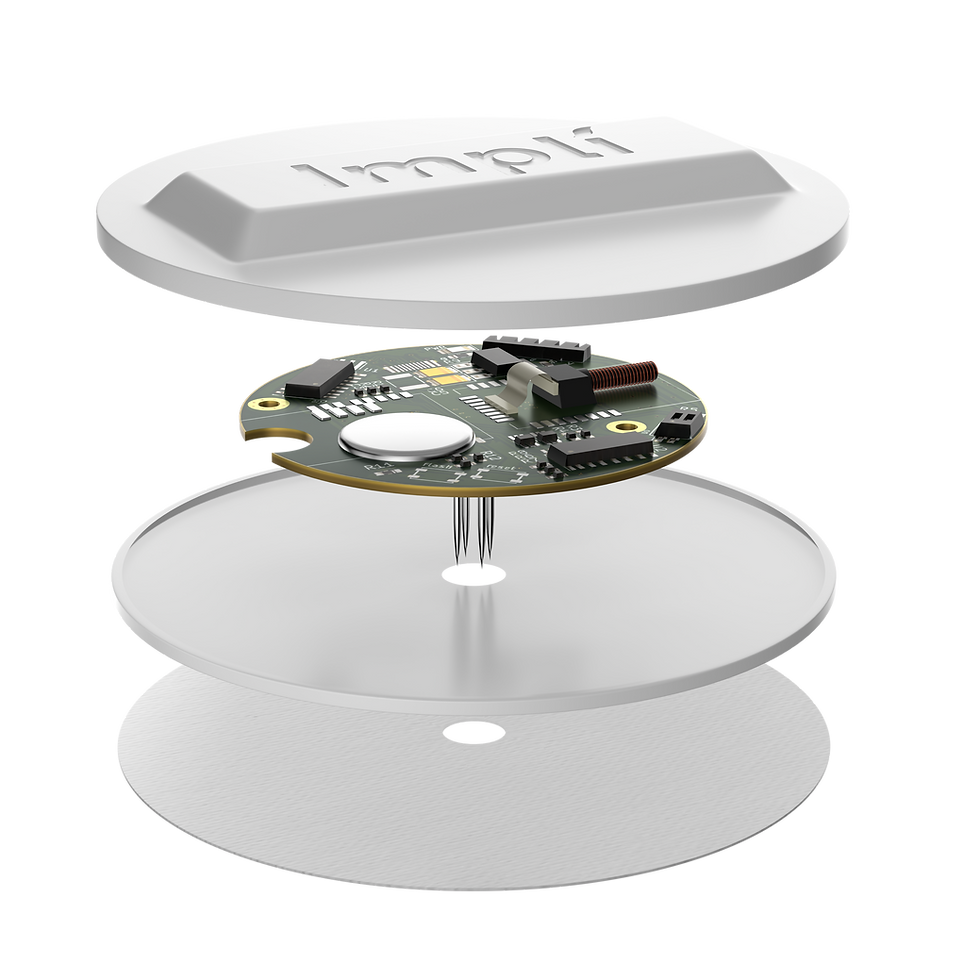
BEAM is Impli's minimally invasive biosensor. Under the SPRIND programme, Impli will expand BEAM from three hormones (oestradiol, LH and progesterone) to five, adding testosterone and 11-ketotestosterone. Aptamer-based electrochemical sensors read hormone concentrations continuously in interstitial fluid, with Impli's proprietary Hormone Atlas™ mapping those readings against blood to make them clinically interpretable.
Quotes
“For years, women with PMOS have been told to wait and see if a treatment is working. That's not good enough, and with BEAM, it doesn't have to be the answer any more. Being selected by SPRIND lets us take the platform we've built for IVF and prove it can do something just as important: tell a patient and her doctor, in real time, whether the drug she's taking is actually working. This is personal for me and we are excited to bring this benefit to women suffering from PMOS.”
Anna Luisa Schaffgotsch, Founder and CEO, Impli
"Continuous measurement of hormones could transform how clinicians personalise treatment and monitor whether therapies are working effectively in people with PMOS,” said Wiebke, “This is an exciting opportunity for close collaboration between engineers, clinicians and discovery scientists. It represents a further step forward in strengthening the translation of discovery science and experimental medicine at the LMS into impactful applications that enhance lives.”
Prof. Wiebke Arlt, Director of MRC Laboratory of Medical Sciences
What the funding supports
Stage 1 funds a 12-month work program spanning sensor lifetime and stability, multi-hormone filament integration, aptamer design and optimisation, system validation and reference-data generation, and regulatory and health-economic strategy. Delivery partners include the MRC Laboratory of Medical Sciences (LMS) at Imperial College London’s Hammersmith Hospital Campus leading clinical planning; and the London Institute for Healthcare Engineering (LIHE) at King's College London, supporting the regulatory route and PMOS health-economic case.
Strategic partnerships and traction
The SPRIND award follows Impli's £1.4 million NIHR i4i grant, announced in June 2026, which is funding first-in-human validation of BEAM in IVF through Imperial College Healthcare NHS Trust. Impli's core sensing platform is protected by patents licensed exclusively and worldwide from Imperial College London, and the company holds an established strategic partnership with Bayer on real-time hormone biosensing. Together, the two awards give Impli parallel validation tracks across its two initial indications, IVF and PMOS, on the same underlying biosensing platform.
Looking ahead
PMOS is Impli's second beachhead on the same BEAM platform that is advancing through IVF, and the SPRIND Challenge is structured to take successful teams from today's proof of concept through to a demonstrated breakthrough over three years. Stage 2 and Stage 3 will enable Impli to extend the platform toward first-in-human PMOS studies and manufacturing feasibility with TTP. Each hormone, each indication and each stage builds on the same core sensing and data infrastructure, the foundation Impli is building for continuous hormone monitoring across women's health.
About Impli
Impli is a deep-tech company building the world's first continuous molecular monitoring platform for hormonal health. Its proprietary aptamer-based biosensing technology continuously tracks molecular signals inside the body and streams real-time data to a smartphone for patients and clinicians to act on. Starting with IVF and now extending into PMOS, the platform is designed to expand across multiple therapeutic areas where continuous hormone data can transform diagnosis, treatment and outcomes. More at impli.co
About the SPRIND Challenge: Continuous Hormone Monitoring
SPRIND (Bundesagentur für Sprunginnovationen) is Germany's federal agency for breakthrough innovation. Its Continuous Hormone Monitoring Challenge funds teams developing biosensors capable of continuously and precisely measuring hormones in everyday life, with the goal of building the first standardised, cross-population reference dataset for continuous hormone data and unlocking new possibilities in diagnosis and precision therapy. More at sprind.org
About the MRC Laboratory of Medical Sciences
The MRC LMS, based at Imperial College London’s Hammersmith Hospital Campus conducts research into the mechanisms of human disease, including endocrine and metabolic conditions, to accelerate the translation of discovery science into clinical benefit. The institute is directed by Prof Wiebke Arlt, who is also currently President of the European Society of Endocrinology. A major area of her research is dissecting the link between androgen excess and metabolic disorder, including major research studies in women with PMOS.
About King's College London / LIHE
The London Institute for Healthcare Engineering (LIHE) at King's College London brings together engineers, clinicians and patient advocates to develop and evaluate medical technologies that are safe, effective and ready for adoption by health systems, with expertise spanning regulatory science, health economics and patient and public involvement.
Contacts
Impli
Anna Luisa Schaffgotsch, CEO
annaluisa@impli.org | www.impli.co
Press Release-8 June 2026
Impli awarded £1.4M NIHR grant to advance world-first continuous hormone monitoring patch for infertility treatment
The award will fund a 30-month consortium programme bringing together Impli, Imperial College Healthcare NHS Trust, King's College London, and Fertility Europe to take the BEAM biosensor from prototype to first-in-human clinical validation.
London, UK, 8 June 2026: Impli, the deep-tech company developing the first continuous molecular monitoring platform for hormonal health, has been awarded a £1.4 million grant from the National Institute for Health and Care Research (NIHR) Invention for Innovation (i4i) programme. The funding will advance BEAM (Bio-Endocrine Analysis Monitor), Impli's minimally invasive microneedle biosensing patch, through clinical validation for use in in vitro fertilisation (IVF).
The award was made in partnership with a world-class consortium including the Imperial College Healthcare NHS Trust Clinical Research Facility and Wolfson Fertility Centre, London Institute for Healthcare Engineering (LIHE) part of King’s College London, and patient advocacy network Fertility Europe, alongside specialist medical device manufacturer TTP.
The clinical challenge
Infertility affects one in six people worldwide. IVF is the most common form of assisted reproduction, yet success rates remain between 15–32%, and as low as 6% for women over 43, while each cycle demands up to 10 clinic visits for blood draws. Clinicians are making time-critical dosing and timing decisions based on hormone values that may be 24–48 hours old. Critical events such as LH surges that determine egg release, progesterone dips that cause implantation failure, early signs of ovarian hyperstimulation syndrome, are routinely missed by single-point tests, with real consequences for cycle outcomes and patient wellbeing.
The technology
BEAM is a biocompatible microneedle patch worn on the upper arm. Aptamer-based electrochemical biosensors continuously measure estradiol, LH, and progesterone in interstitial fluid, transmitting data wirelessly to a smartphone where AI algorithms convert raw signals into real-time hormone trends. BEAM is the wearable first step in Impli's broader platform roadmap — the same biosensing foundation underpins the company's longer-term vision for fully implantable, long-duration monitoring, beginning where clinical need is most acute and the regulatory path most accessible. By replacing up to 10 clinic visits with as few as 2, BEAM enables personalised, real-time protocol adjustment with the potential to meaningfully improve success rates and reduce preventable complications.
%20(1).png)
.png)